
Jayden Bogle’s challenge on Mathys Tel left Tottenham supporters asking an obvious question: if VAR considered it reckless, why did the Leeds defender finish the incident without a yellow card?
The answer involves two separate judgements. Was the challenge serious enough for a red card? And, if not, could VAR step in just to ensure Bogle was booked?
Those are not the same question.
What happened at Elland Road?
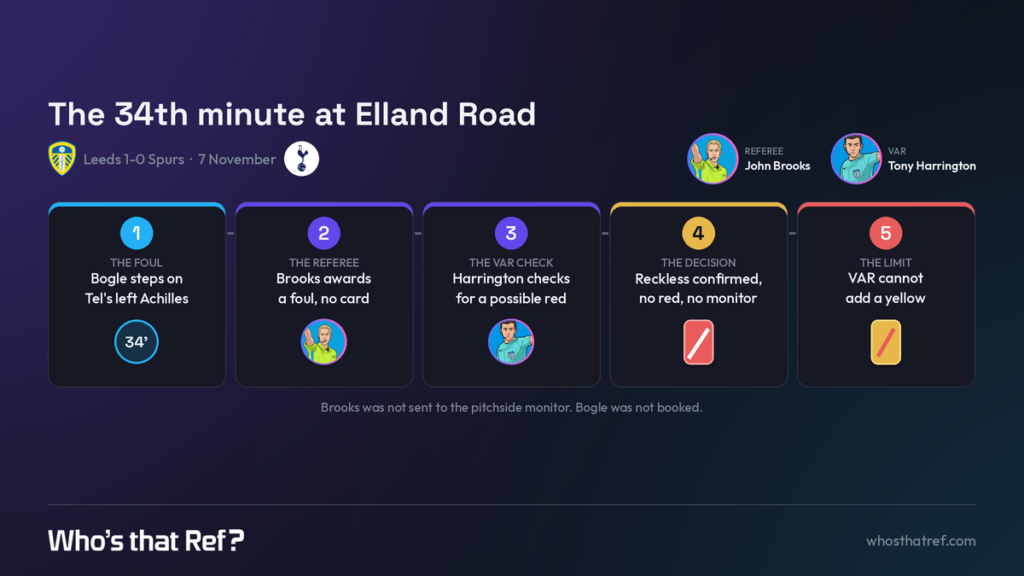
In the 34th minute of Leeds’ 1-0 win over Tottenham at Elland Road on 7 November 2026, Bogle fouled Tel, stepping on his left Achilles. Referee John Brooks awarded a foul but did not show a card.
VAR Tony Harrington checked for a possible red card. The Premier League Match Centre said the on-field decision of no red was checked and confirmed, and quoted Harrington:
“I’m confirming the on-field decision of no red card. There’s a lack of speed going into the challenge and he’s stepping into the tackle. Confirming a reckless challenge.”
The same wording appears in the Premier League’s Matchweek 10 VAR recap. Brooks was not sent to the pitchside monitor. Bogle was not booked for the incident.
What does “reckless” actually mean?
In football’s laws, reckless is not simply another word for a bad-looking tackle. It is a disciplinary category.
IFAB’s Law 12 defines it as follows: “Reckless is when a player acts with disregard to the danger to, or consequences for, an opponent and must be cautioned.”
A careless challenge needs no disciplinary sanction. A reckless challenge must be cautioned. Using excessive force, which includes endangering an opponent’s safety, requires a sending-off.
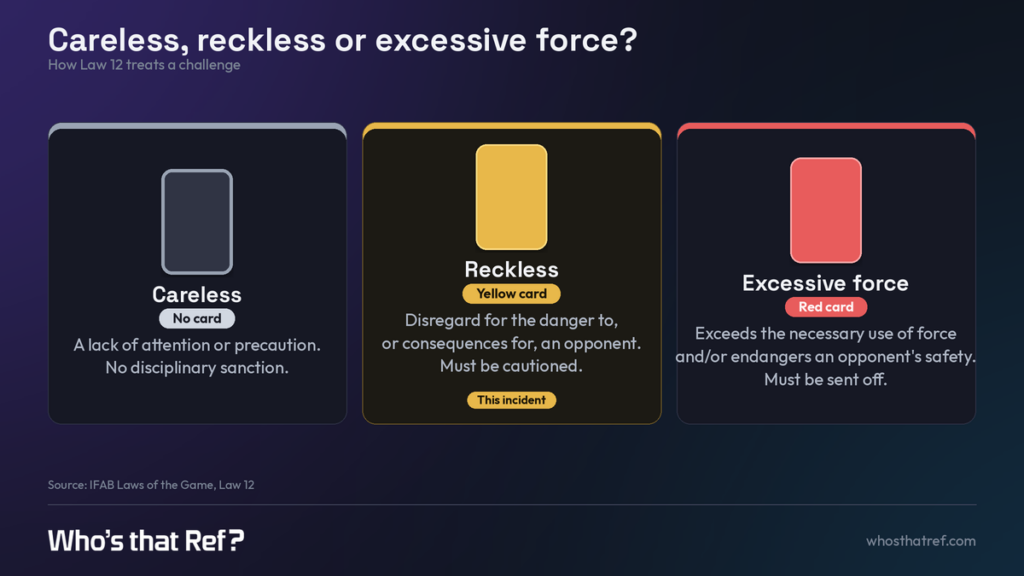
That explains the frustration. The description supporters heard pointed towards a booking, but the outcome was no card.
Why couldn’t VAR simply tell Brooks to book him?
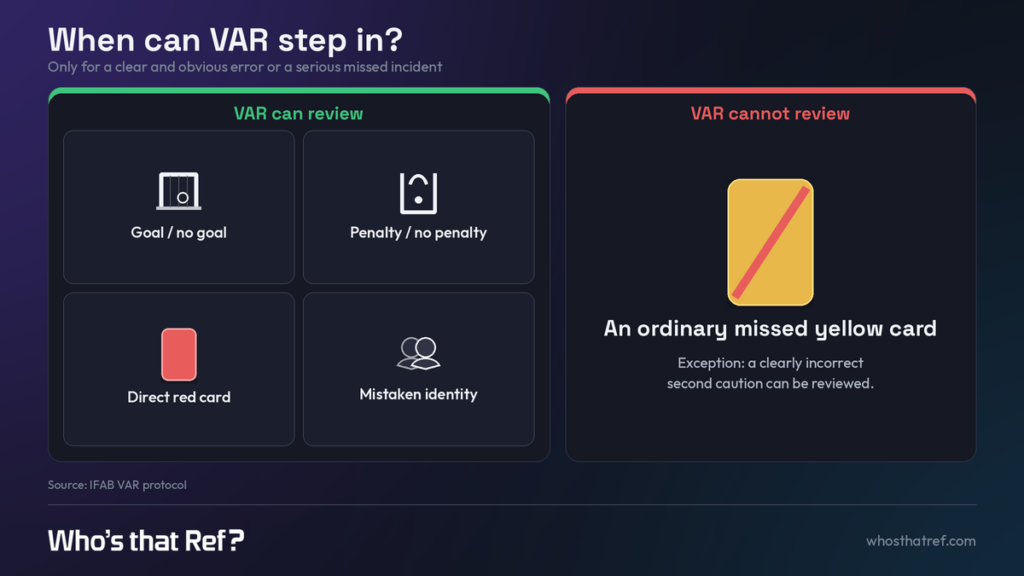
VAR is not a second referee with permission to correct every missed decision.
In this incident, Harrington was checking whether the challenge warranted a direct red card. As BBC Sport’s analysis noted, a reckless challenge is a yellow card, but VAR could not intervene merely to advise that Bogle should be booked.
That sits with the IFAB VAR protocol: VAR may assist only for a clear and obvious error or serious missed incident in relation to a goal, a penalty, a red card (not an ordinary missed caution) or mistaken identity.
Once Harrington judged that the no-red decision should stand, the check did not become a separate review of whether Brooks had missed an ordinary caution.
That does not make a reckless challenge a no-card offence. It means the on-field referee’s disciplinary decision and VAR’s power to intervene operate within different limits.
Can a VAR review ever end with a yellow card?
Yes. Saying “VAR can never lead to a yellow” would be misleading.
The IFAB VAR protocol includes a specific example: VAR recommends an on-field review for a possible red-card challenge, but the referee watches the footage and decides it was only cautionable. The referee must then show yellow.
The important distinction is why the review was initiated. A legitimate possible-red review can end in a caution. VAR cannot manufacture that review simply to correct a missed ordinary booking.
Bogle’s incident did not reach that on-field review stage.
Does that settle whether it should have been red?
No. Explaining the process is not the same as endorsing the assessment.
Supporters can still question whether the contact endangered Tel’s safety and whether Harrington should have recommended a monitor review. The official explanation tells us why the decision stood; it does not remove the debate.
Nor should a still image or slow-motion clip be treated as the whole assessment. The protocol distinguishes identifying the point of contact from judging the intensity of a challenge, for which normal speed matters.
The question worth asking
The most useful debate is not simply “Why didn’t VAR give a yellow?” It is whether the possible-red decision was assessed correctly, and whether football wants VAR’s remit expanded to correct missed cautions.
Those are different discussions. Keeping them separate makes it easier to challenge a decision without confusing who was responsible for it.
At Who’s That Ref?, that distinction matters: the referee and the VAR do different jobs, even when both are involved in the same incident.