Assists get the credit. But what about the pass before the assist?
Pre-assists are one of those football stats that barely get talked about. Which is strange, because they tell you something that most stats don’t. Expected goals tells you about shot quality. Assists tell you who played the final ball. But pre-assists tell you who started it. Who made the assist possible in the first place.
What even is a pre-assist?
A pre-assist is the final intentional completed pass to the player who records the assist, within the same uninterrupted attacking phase of play. The rules matter here. There can be no turnover, no stoppage, no major defensive reset between the pre-assist and the goal. The chain has to be clean and direct. If possession is lost and regained, the sequence resets. If play stops, the sequence resets. Only the pass that directly sets up the assister, within the same flowing move, qualifies.
It sounds simple. In practice, manually logging every Everton goal this season and tracing each sequence back further is time consuming. But that’s what I’ve done.
What the data shows:
Out of 46 goals in 36 games, 23 involved a qualifying pre-assist. Just over half of Everton’s goals this season had a traceable, direct pass before the assist that met all the inclusion criteria.
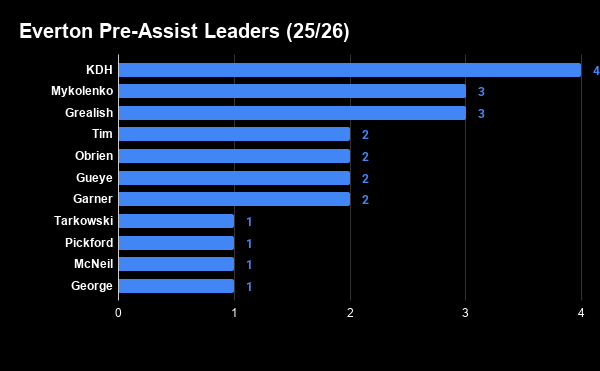
The leading pre-assister is Kiernan Dewsbury-Hall with 4. Grealish and Mykolenko are joint second with 3 each.
That Mykolenko figure is the one that jumps out. As an Everton fan who has watched him receive a lot of criticism this season, seeing him sit alongside Grealish in this list is genuinely surprising, in a good way. A left back contributing to the start of goal sequences at the same rate as one of the club’s most creative attackers is not something you would ever find in a standard stats breakdown. Pre-assists are exactly the kind of metric that surfaces players who do important work without ever getting the recognition for it. Mykolenko is a good example of that. Grealish is also a potential summer signing and this is one of the stats that support why we should consider it.
Further down, Tim, Obrien, Gueye and Garner all sit on 2. Tarkowski, Pickford, McNeil and George each have 1. The fact that Pickford and Tarkowski appear at all is a reminder that pre-assist sequences can start from deep. A goalkeeper’s distribution or a centre back’s long pass can be the beginning of a goal chain even if it rarely gets framed that way. Image credit: BBC Sport

The pairings:
Looking at which players combine most often in pre-assist sequences adds another layer. Mykolenko to Grealish, KDH to Garner, and Gueye to Grealish are the only pairings that appear more than once across the whole season. Two of the three most frequent combinations end with Grealish receiving the pre-assist pass. That tells you where Everton’s attacking patterns are most concentrated. The left side, through Grealish, is where a significant proportion of goal-scoring moves begin to take shape. This should speak volumes considering he’s been injured since mid January.
The KDH to Garner combination is interesting for a different reason. Both players are central midfielders. That pairing appearing twice suggests Everton are also building through the middle with some regularity, even if the left side dominates the picture overall.
How Everton are building goals:
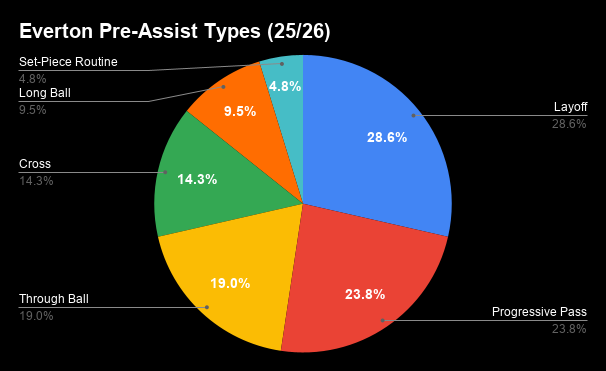
The pass type breakdown is worth spending a moment on. Nearly 29% of pre-assists are layoffs, the simplest pass in football. Almost 24% are progressive passes that move the ball significantly further up the pitch. Through balls account for another 19%, crosses for 14%.
What that distribution suggests is that Everton are not building goals through elaborate or high-risk passing. The most common pre-assist type is a ball played back or sideways to create a better angle or release a teammate. The second most common is a direct forward pass that advances play quickly. Everton are moving the ball simply and effectively in the phases that lead to goals, even when the goals themselves might look complicated.
Why this matters:
Standard football statistics reward the end product. Goals, assists, shots on target. They tell you who finished the move. Pre-assists ask a different question: who made the move possible?
Some players show up in every stat. Pre-assists find the ones who don’t. And for a club like Everton, where certain players have carried criticism all season, it’s worth knowing which of those players are actually showing up in the data when it counts.
This is part of an ongoing set of personal projects I’ve been building alongside Who’s That Ref?, all sitting at the intersection of football and data. If you work in the industry and want to connect, you can find me on https://www.linkedin.com/in/laurachloemadden/.
Leave a Reply